The Question Rex Wouldn't Let Go
Should Pawsome Provisions buy a veterinary SaaS platform? The number that looked healthy — and the one underneath it that wasn't.
Hannah Bernard had seen this play before — just from the other side of the table. Before Pawsome, she'd lived inside SaaS metrics for a living, and she was the one who convinced Pawsome that a pet food manufacturer could benefit from thinking like a software company. When the board started asking where the private label windfall should go next, she pointed at FetchTrack: a cloud-based veterinary practice management platform with steady logos, healthy usage, and a name that fit the portfolio.
Anna Analyst-Pomsky pulled the data. On paper, FetchTrack looked like exactly the kind of asset Pawsome should want — 105% net revenue retention, a growing ARR base north of $12M, and a customer list that wasn't going anywhere.
Then Rex Pointer — VP of Sales, 15 years in, still not fully sold on private label either — asked the only question that mattered to him:
"Fine, NRR's healthy. But once we land a clinic, what do we actually sell them next year?"
Anna didn't have a good answer. So she went looking for one — and found the real story sitting underneath the headline number.
Show Me the Proof
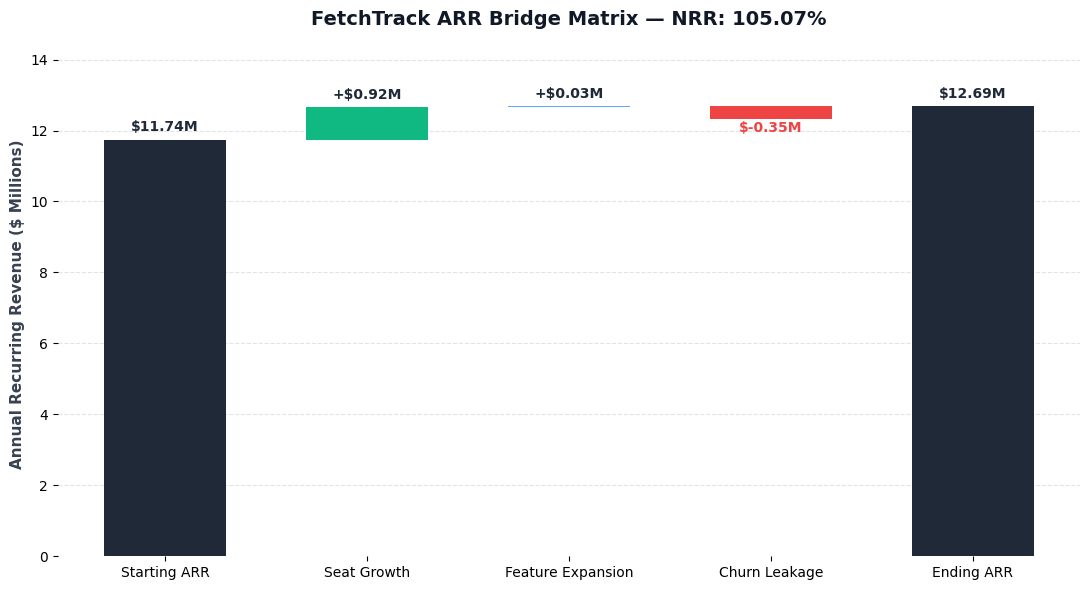
The headline: 105% net revenue retention, comfortably healthy. But the bridge already hints at the story — seat growth is carrying almost the entire gain.
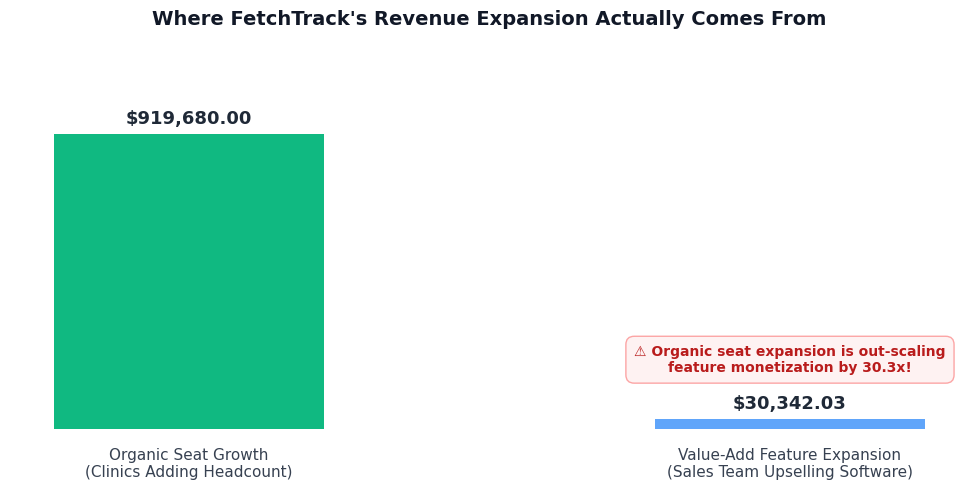
Rex's question, answered in one chart: organic seat growth is outpacing actual product-driven expansion by more than 30x. Clinics aren't buying more from FetchTrack — they're just getting bigger and paying for more seats on the same product.
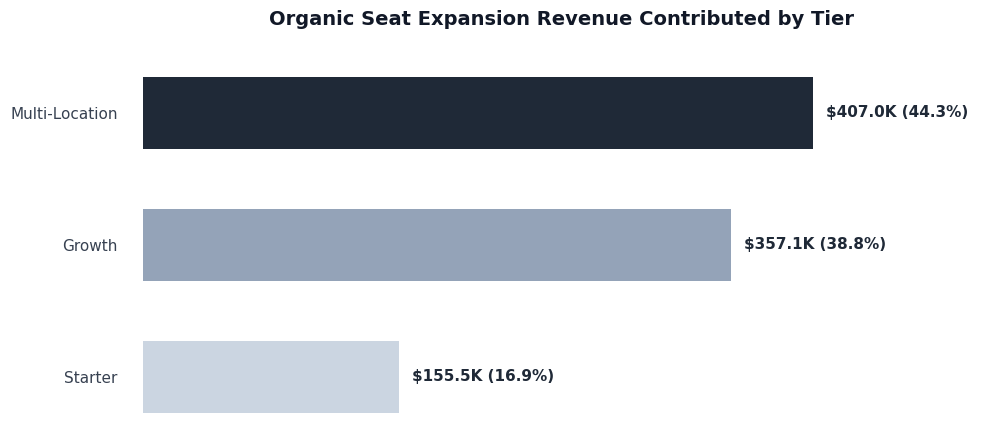
And that growth isn't even broad-based. Multi-Location accounts — barely 11% of the customer base — generate 44% of all seat-growth revenue. A handful of large accounts hiring more staff is propping up a number that looks, from a distance, like company-wide health.
Additional Detail
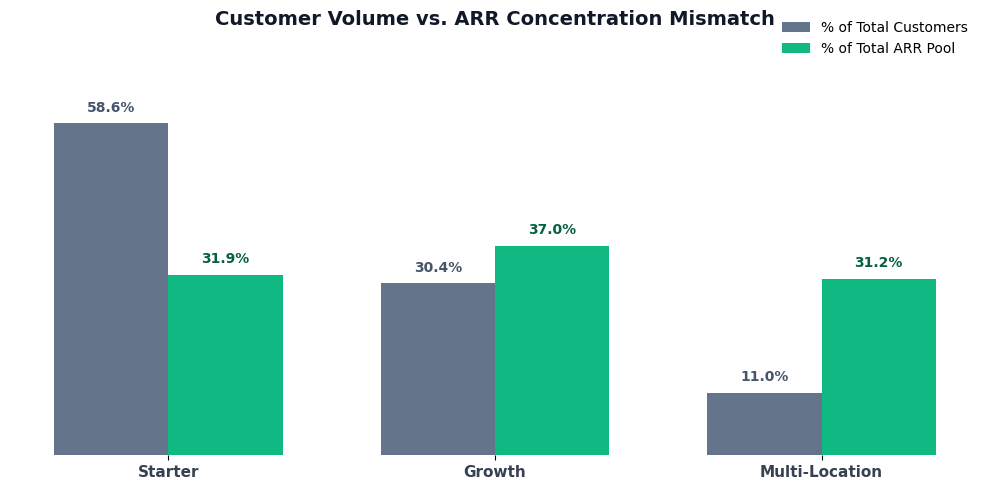
The same concentration, from another angle: Starter clinics make up nearly 6 in 10 customers but less than a third of ARR.
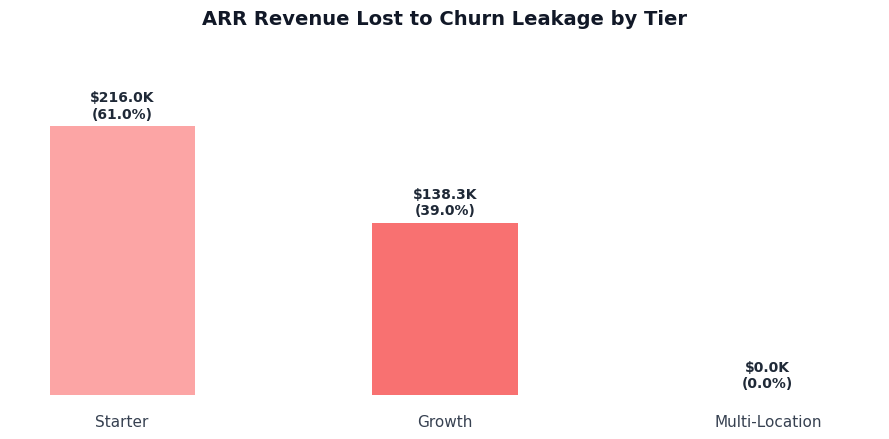
For context: churn is real but manageable, and concentrated entirely in the smaller tiers — it's not the reason to walk away.
The Verdict
FetchTrack isn't a bad asset. It's a real product with real retention and a loyal customer base. But its growth story has a ceiling: there's no payment processing, no add-on modules — nothing to sell an existing customer beyond more seats. Rex's sales instinct exposed a real product gap, not just a spreadsheet nitpick.
Anna's recommendation wasn't "walk away." It was "don't buy this expecting a growth engine — buy it, if at all, expecting to build the expansion motion FetchTrack never had." That's a very different deal, with a very different price — and a very different post-acquisition build list for whoever has to deploy it.
Could the Long Tail Handle Itself?
The acquisition question answered whether FetchTrack was worth buying. It didn't answer how Pawsome would actually manage it — especially the hundreds of small, single-vet accounts that make up most of FetchTrack's customer base but least of its revenue.
So I went further: built out tier definitions, five features' worth of telemetry, three separate health signals (not one blended score — that mistake's already been made once in this story), and a working triage tool that scales the same logic to hundreds of accounts instead of one memo. View the prototype →
The memo made it back to Hannah and the board. Whether FetchTrack is worth building into — or worth passing on — is a question for the next round of diligence.
A Note on AI Assistance
Claude (Anthropic) was used for conceptual walkthroughs, narrative structure, and code review while building the simulated FetchTrack dataset and charts. All design decisions, domain framing, debugging, and implementation are my own work.
AI was used as a collaborative assistant, not a replacement for engineering judgment.